| 0 comments ]

Courtesy of Google, quite a few artistically inclined young people are going to have a great summer. The search giant has announced a new phase in its annual Doodle 4 Google competition, and it's also started a Google Photography Prize contest.

The Doodle 4 Google challenge has reached a point at which there are only 40 regional winners left. All of their designs will be shown in the Smithsonian's Cooper-Hewitt, National Design Museum between May 21st and July 5th, which is neat.

Google Contests

In the meantime, a public vote ending May 18th will finish off process of picking a winner, and said winner will get a $15,000 scholarship along with a few other prizes.

As for the photography contest, entrants are supposed to supply five photos that will make up an iGoogle theme, and a post on the Google Photos Blog explained, "Winning submissions will be available for millions of Google users . . . and will also be part of a special exhibition at the Saatchi Gallery in London. The overall winner will also receive 5,000 ($7,500) and an invitation to spend a day with renowned photographer Martin Parr."

The Google Photography Prize is open to college students and will run until May 31st.

| 0 comments ]

Nearly half of Internet users who respond to display advertising eventually do a search related to the ad they viewed, according to a new study from iProspect.

The study found search engine marketing and display advertising have a closer relationship than many marketers have thought. The study shows that Internet users initially respond to the medium as follows: 31percent responds by directly clicking on an ad; 27 percent respond by searching for a product or brand on a search engine; 21 percent respond by typing the company Web address into their browser and visiting the website; and 9 percent respond by using social media. Overall, 52 percent of Internet users actively respond to display advertising.


Robert J. Murray

"The key message from this study is that online display advertising is far from dead -- its 31% direct response rate confirms that," said Robert Murray, CEO, iProspect. "However, it is interesting to see that almost as many people initially respond to display ads by performing a search as those who actually click on an ad. In essence, search becomes an alternative mechanism for Internet users to respond to online display."

"Considering that, this finding has an important message for marketers -- if they are going to invest in online display, then they should leverage search marketing to help them capture the demand that display advertising creates. In other words, they should consider search as a form of insurance for their display investment."

One third of Internet users (33%) who respond to display advertising eventually purchase from a company with which they are familiar - more that twice the number who eventually purchase after learning of an offering/company for the first time from display advertising (14%).

"At the end of the day, the findings from this study closely tie search and online display advertising together," said Murray. "Overall, they tell a story of improved efficacy, which is a message that marketers should find particularly compelling during these trying economic times when they are being asked to do more with less."

| 0 comments ]

There's a short but interesting blog post up on Google's official Public Policy Blog, which states six principles the company holds with regards to competition and openness.

Adam Kovacevich"As Google has grown, the company has naturally faced more scrutiny about our business principles and practices," says Google's Senior Manager of Global Communications and Public Affairs. "We believe that Google promotes competition and openness online, but we haven't always done a good job telling our story."

He notes that the company has been meeting with policymakers, think tank reps, academics, journalists, ad agencies, and trade associations in the US and Europe.

1. Help other businesses be more competitive.

2. Make it easy for users to change.

3. Open is better than closed.

4. Competition is just one click away.

5. Advertisers pay what a click is worth to them.

6. Advertisers have many choices in a dynamic market.

Google actually has a 53-minute webinar available for download

on the topic of Google competition and openness. The webinar took place back on April 9th, but presumably in an effort to be more open with this, Google is throwing it in the spotlight so others can learn from it.

The posting of these materials appears to be a response to recent media coverage of antitrust concerns regarding the company. Earlier this week the FTC launched an inquiry into whether the overlap of directors on the boards of Apple and Google violates antitrust laws. CEO Eric Schmidt sees no conflict with the Apple Board seat.

| 1 comments ]

This summary is not available. Please click here to view the post.

| 0 comments ]

If you didn't hear - Google unveiled DoubleClick Studio, a free rich media production and web-based workflow tool that promises to help users develop and produce rich media ads.

A post on the Official Google Blog provides an explanation of the advantages of this move by saying that the company hopes to "expand the number of advertisers that can make these useful formats part of their marketing strategy."

What is Rich Media?

The post describes Rich Media as follows:
To describe rich media, it helps to think about other ad formats that we're all familiar with, starting with the simplest: text ads. With just a few keystrokes, anyone can create simple messages in a standardized format, and place them on a site like Google.com in minutes. Then we have standard display ads, ads that usually include text with a visual such as a logo or a graphic. These can be in formats we're all familiar with like .jpg, .gif, .swf and more. Standard display ads can either be static or animated with tools like Flash. They typically have only one interaction, meaning that when you click on them, you'll be taken to a destination site. And then at the most complex level, from a design and interaction perspective, we have rich media ads. With rich media, you can have ads that expand when users click or roll over, for example, and there are extensive possibilities for interactive content, such as HD video or even the ability to click to make a phone call.
Here is an orientation video that outlines all sorts of ideas and possibilities.


maximizingrevenuetips.blogspot.com


They conclude: "This is also a good thing for Internet users; rich media capabilities make advertising even more useful, letting a viewer interact with an ad and learn about a brand without having to leave the page they're on. And, advertisers have an expanded creative canvas within the ad itself, allowing for deeper, higher-quality content in the ad itself. At Google, we believe that ads at their best are useful information."

What do you think? Will this tool help us as intended by Google? In you want to create your own video ad, this tool might just be right for you. Access DoubleClick Studio with your existing Google account and find out more.

| 1 comments ]

So many affiliate programs out there - which one really works? It may seem a difficult question to answer and once you start looking through the affiliate websites, you may get lost in a sea of attractive promises. How do you then decide which is the best one for you and how to make money online with affiliate programs?

Make money online with affiliate program has become an extremely popular source of making money on the internet. The basic idea of affiliate marketing is based on links. You put up links on your website to lead traffic to another website. If they make a purchase from the site, you get a percentage commission.

1. Payout rates and Payment Structure

Some affiliate programs are single tier ones while others have multiple tiers. This means that if anyone you referred to the program makes a sale, you get a commission from there too. To make money online with affiliate program, try and look for such an affiliate program, as the payout will be higher. You must also check out the program's payment structure before joining. Always look or a program that pays a high rate of commission.

2. Reliability

An important aspect to consider is reliability. Run a few quick searches and check how reliable the website is, its credibility etc. Also see if it pays on time, frequency and if it clears its dues fully.

3. Upfront fees

Affiliate programs that charge a registration fee or any upfront payment are best avoided. C'mon - if you went looking out for a job, you wouldn't pay the employer to allow you to work! Another advantage is that you can opt out if it doesn't seem to suit you. Those who talk of refunds usually drive you crazy before they return your money, if at all. A company confident of working well will definitely not charge you anything.

4. Statistics

Look for an affiliate program that gives you a clear and comprehensive statistics page. You should be able to view your statistics 24/7. A good statistics page will show you the number of clicks you have received, where the majority of clicks are originating and how much cash you have earned from your links. The system should be transparent and your stats should get updated immediately.

5. Conversion Rates

Look into the conversion rate of the affiliate program. This will give you an idea of how many people actually make a purchase after clicking on the link. For example, a conversion rate of 1% implies that for every 100 visitors who clicked on the link, the website made one sale. 2% is a reasonably good conversion rate. Be wary of those who claim to have abnormally high conversion rates, as more often than not, they are scams.

6. What the site sells

All said and done, a key factor and narrowing down your list of affiliate programs is the product or service that the website offers. What is it? Will people pay for something like that? Only if the product or service is impressive, will people shell out money and actually buy it.

A reliable affiliate program can turn out to be a great source of easy income for you. To make money online with affiliate program, it requires no long hours, no angry bosses, no traffic snarls to get caught in - what more could you want?! If you've found a good affiliate program with a high conversion ratio and a reliable payout rate, half your battle is already won. Now you just need to sit back and watch your money tree grow!

Btw:You can check my post where i put different ways to make money online with affiliate programs.

| 0 comments ]

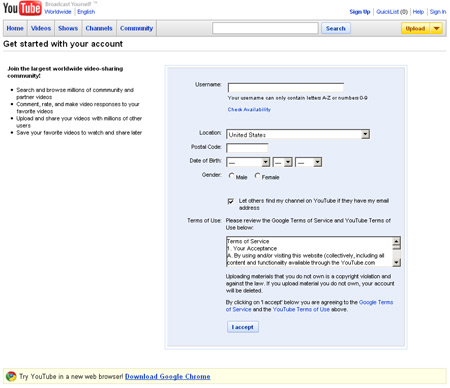
Beginning today, people who sign up for YouTube will be given a Google account. Given that Google has owned the popular video service since 2006, it is a little surprising that this happened in the past, but it certainly makes sense that they would do it sooner or later. Note: I am not yet seeing an indication of this news on the YouTube sign up page, but I assume it’s in the process of rolling out.

YouTube Sign-up Page

It's a smart move because it opens the door to other Google services that YouTube users may not have otherwise been privy to or taken the time to acknowledge. Things like iGoogle, Google Reader and Google Docs for example.

Really, the move could provide a tremendous boost to Google's social media efforts, which it has seemingly been taking much more seriously lately. As I've discussed before (though I cited Gmail as the central point), Google itself has kind of been a social network for years, and many just haven't realized it.

Now in recent weeks, they have put much more emphasis on the Google Profile, which is now showing up in search results, and offers the option of vanity URLs for easier visibility. YouTube has long been a huge social network (not to mention the 2nd largest search engine). Why not incorporate that more into the rest of Google? It's arguably the company's biggest and most well-branded social media entity.

Users can still sign up for YouTube with any email address, and they'll still pick a unique username. "So why are we doing this?" asks James Philips of the YouTube Team. "We feel that by jointly connecting accounts, you can take greater advantage of our services both on YouTube and on Google, especially as we start to roll out new features in the future that will be powered by Google technology."

Those who already have a YouTube account but no Google account will still be able to enjoy YouTube just the same, but Philips says they will be rolling out features that will require a Google account in the future. Such features are not elaborated on, but I am very eager to see what these will be.

I would not be surprised to see a prominent YouTube link start showing up on Google alongside things like web, images, maps, news, and Gmail. There is already one for video that goes to Google video of course, but I have often pondered why YouTube would not be featured here. It's obviously the more popular video engine.

| 0 comments ]

The "what is Twitter about?" article is not a new concept. It's been discussed frequently pretty much since Twitter was launched. Yet people still have a hard time grasping the concept. In fact, Twitter has had a hard time with user retention most likely because so many people try it based on all of the hype, and then don't return because they don’t "get it." What is Twitter about to you in one word?

Social Network Reach
The truth is, it often takes a while using the service to "get it." The more you use it, the more you start to realize the benefits that are there. I (with a little help from Mike and Tiffany) asked a whole bunch of people what Twitter is "about" to them in one word. A handful of them responded, and here are some of the answers I got:

- Updates
- Egos
- Networking/Networks
- Relationships
- Represent
- Connection
- Possibilities
- Instant
- Marketing
- Speed
- Noise
- Inane
- Communication
- Contrived
- Aggrandizement
- Useful
- Spammy
- Conversation
- Open
- Freedom
- Useless
- Awareness
- Chat

Going into this thing, the word I was clinging to in my mind was microblogging. It has always been described with this word, but what does that mean? Small blogging. To me, Twitter is not a whole lot different than a collection of blogs, only all of the entries are really short (140 characters or less).

Is there a lot of noise? Sure. Could the same thing be said about the Blogosphere? Absolutely. You read blogs because they are written by people who talk about topics you are interested in reading about, or because you're interested in what the blogger has to say because of who they are. The same could be said about Twitter. You follow those whose thoughts you are interested in hearing, whose links you are interested in sharing, whose company's you are interested in staying informed about, etc.

Company Twitter accounts are no different than company blogs for all intents and purposes. The same goes for personal accounts and personal blogs. Do you care what I ate for breakfast? Probably not, but someone might. And I could've just as easily posted the same info on my personal blog. The difference is that on Twitter, I would've got right to the point - I didn't have any breakfast this morning. A blog entry might have taken several paragraphs to explain the reasoning behind this. If these are the only things I blogged about, you'd probably stop reading my blog.

If these are the only things I tweeted about, you'd probably stop following me. If twitter accounts are like blogs, then Twitter is like its own Blogosphere (or microblogosphere) combined with a feed reader. You select the ones you want to follow, just as if you were selecting what blogs to subscribe to.

To me, this is what Twitter is about. That’s not all it’s about, but that’s how I get the most use out of it. That’s probably why I am not an incredibly frequent Twitterer per se. I read Twitter a lot more than I write on Twitter, but that’s still using it. Neville Hobson recently wrote about how Twitter is for listening. For some of us, that is the biggest part of it, but still for others, it’s speaking. We couldn’t listen if nobody was talking.

It is clear that Twitter is about a variety of different things to different people (and nothing to others). One person's microblogging service is another person's networking platform. There is certainly plenty of crossover as well. It doesn't have to be about strictly one thing. It's whatever you want it to be. And if you don't want to use it, nobody's putting a gun to your head (hopefully).

Thank you to all who participated in my little survey. I’m not sure if we’ve helped anyone “get” it or not, but either way it was interesting to see the different words people came up with. Somehow, I didn't get many repeats. Twitter obviously fits different molds for different people. But we already knew that.

Make Money Now!!

An online guru making more in a single month than most people make in a year is finally revealing his top money making opportunity.  Click here to learn more.
If you wish to no longer receive emails, please click here.
Or write to: Suite 208 – 260 West Esplanade North Vancouver, B.C. V7M3G7 Canada