| 0 comments ]

Google has introduced a set of new ad templates for its Display Ad Builder tool. The templates, which Google refers to as "elegant" reside in the "general" category.

"These templates have ready-made buttons and backgrounds that give each ad a cohesive look and feel," says Dan Friedman of Google's Inside AdWords Crew. "More specifically, the backgrounds use subtle gradients and the new buttons have unique shapes, icons and color treatments. The goal of these ads is to make it as easy as possible to create high-quality ads in a matter of seconds without having to use complex graphics software."

Display Ads templates

With some of the new templates, advertisers need only upload their product image and write some text, and the template pretty much takes care of itself. For the design-impaired, it's a good way to easily create a decent looking ad.

In addition, most of them seem to cater to "clickiness," meaning they make it easy for a call to action to inspire a click. aka. You can make money online.

To use the templates, just click Display Ad Builder on the Create an Ad page in AdWords. Google Display Ads features over 90 different templates. Google offers a display ads tutorial here.

| 1 comments ]


You probably have heard stories about businesses that will pay you just to drive around with an advertisement on your car, but do these opportunities really exist? And, if so, how do you find them?

They're called "free car" programs or "get paid to drive" promotions. These programs do exist, although they aren't as plentiful as they once were. The key is knowing where to look and having what it takes to make you an ideal advertising driver.


How it works

Here's the basic premise of the "paid to drive" concept: A company seeks people -- regular citizens, not professional drivers -- to go about their normal routine as they usually do, only with a big ad plastered on their car. The ads are typically vinyl decals, also known as "auto wraps," that almost seem to be painted on the vehicle, and which often cover a large portion of the car's exterior surface.

The car owner is then compensated, usually a few hundred dollars per month, which is essentially a "rental" payment for letting the company use that space. In the past, there's also been a "free car" version of this concept. The company provided the driver with a new, prewrapped car. In this situation, the drivers usually didn't get any cash; their payment amounted to the free use of a new car. However, companies quickly discovered that giving away a bunch of free cars didn't make economic sense, so few still take this approach, says Drew Livingston, president of Free Car Media in Los Angeles.

What does the company get out of this type of ad strategy? Lots of exposure. The auto wraps tend to be colorful and eye-catching and attract lots of attention. Plus, it's a form of advertising with a captive audience, meaning people who are stuck in traffic and can't avoid seeing the wrapped car alongside them, Livingston says.

The companies usually select drivers who live in desirable locations such as high-traffic, urban areas. A company's ideal driver can vary depending upon the target demographic they want to reach, according to Brandon Clarke of DrivenMedia, a Phoenix-based advertising company that specializes in creating branded vehicle campaigns for clients. For example, a tech or electronics company may seek drivers who live on or near college campuses, so as to gain exposure with the college crowd.

The vehicles in these programs are often equipped with GPS tracking devices, so the companies can make sure the drivers spend sufficient time in the desired areas.

'Paid to drive' primetime

Paid-to-drive programs were very popular five to 10 years ago. Gas was cheaper, and people were spending more time on the road. There were plenty of Web sites devoted to these programs, including many fee-charging sites that acted as a middleman and promised to connect willing drivers with companies seeking vehicles for their ads.

Then, fuel prices spiked and people weren't spending as much time in their cars, Clarke says. At the same time, online advertising became the rage.

Current opportunities

Still, there are opportunities out there, if you know where to look.

Livingston says his company's client companies still have plenty of campaigns running nationwide. Business slowed slightly right before the recession but returned when the economy started going south.

"Consumers are seeking ways to make money, while companies are cutting back on spending for television campaigns and looking for more affordable advertising strategies," Livingston says.

On average, Livingston's clients put about 800 to 1,000 wrapped cars on the road.

Like other similar companies, Free Car Media serves as a matchmaker. Interested consumers register at MyFreeCar.com and then are notified when they meet the criteria a client seeks in potential drivers.

Drivers are paid an average of $700 to $900 per month, with campaigns usually running a few months long. Drivers use their own cars which are fitted with the wrap. "They don't actually get a free car," Livingston says. "But the monthly payment is generally enough to cover their auto expenses like car payment, gas, etc., for the month, so that's where the name comes from."

It doesn't cost anything for drivers to sign up, and Livingston warns people to avoid any sites that do charge a fee.

"There are a lot of unscrupulous companies that want to charge you $20, $30 or more when you can get this information yourself for free. I get calls on a weekly basis from people who are upset because they were scammed," he says. Livingston says that anyone who is directed to his site after paying a fee to another service should demand a refund.

Adding to the confusion, many of the sites -- legitimate and questionable -- have very similar names, often some variation of the words "free" and "car." So it's important to check out the Web site carefully, watching for any mention of fees or membership costs.

Finding drivers

Clarke says his company puts a lot of effort into recruiting brand influencers, or drivers who are a perfect fit for the client's target audience.

"Recent engagements have focused on family-oriented and consumer driven advertisers who are generally trying to create awareness within a specific region among active moms with active families," Clarke says, adding that busy soccer moms would make perfect driver candidates for these campaigns. "With active families being such a coveted demographic, incorporating their vehicles is ideal since they're getting tremendous exposure parked in the pick-up line at school, at the Saturday morning soccer games, etc."

There are important criteria for driving candidates. "Background, driving record, employment verification, personal interview, as well as having mandatory minimum auto insurance coverage are part of the vetting process," Clarke says. "We're also looking to incorporate an online personality assessment tool and a short online defensive driving course."

Interested drivers can sign up for opportunities at Drivenmediaonline.com. "We compensate drivers within a range of $300 to $500 per month, with incentives and other engagements that allow them to earn more," Clarke says. "Our typical campaign lasts three to six months, with the time frame and vehicle type being the primary factors for determining their monthly compensation."

So imagine that you have a big sticker saying "Google Is Your Friend" on you car,imagine....:)

Comments are welcome.

| 0 comments ]

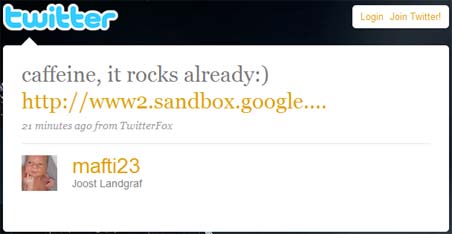
Google may have a huge lead over its competitors in terms of market share, but the search giant isn't resting on its laurels. A next-generation infrastructure codenamed "Caffeine" has been unveiled, and it's already available for individuals to test.

Fair warning: don't expect Caffeine to introduce natural language recognition, search results from Twitter, or anything else too fancy. Matt Cutts cautioned, "The Caffeine update isn't about making some UI changes here or there. Currently, even power users won't notice much of a difference at all. This update is primarily under the hood: we're rewriting the foundation of some of our infrastructure."
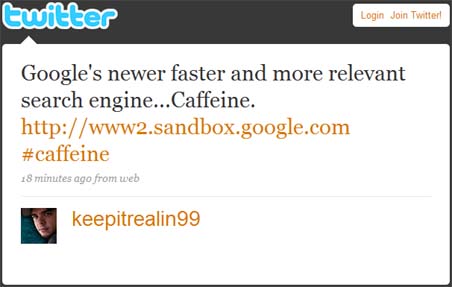
Still, he continued, "[S]ome of the search results do change, so we wanted to open up a preview so that power searchers and web developers could give us feedback."

Head over to http://www2.sandbox.google.com if you intend to take Cutts and Google up on their invitation. Keep an eye on characteristics including accuracy, comprehensiveness, and - perhaps especially - indexing speed. Then, if you've got anything constructive to say, use the "Dissatisfied? Help us improve" link at the bottom of the page and include the term "Caffeine" in your response.

Initial impressions have, as you can see below, been mostly positive.

Caffeine is likely to hit the mainstream in the near future. Cutts referred to this sneak peek as "a preview of how the search results will change over the next few weeks and months."

| 1 comments ]

Probably the most important step in getting your site found in a search engine is the one in which the search engine crawls it. There are things that can be done and things that can be avoided to make this process as painless as possible for the search engine, which will in turn, make it as painless as possible for the webmaster.

Since Google dominates the search market share by such a large market share, it is always a good idea to listen to what they have to say about such matters. So when they post a presentation with tips on optimizing crawling and indexing, you'll probably want to pay attention.

Google has done just that, highlighting things to stay away from, and things you can do to enhance your site's crawlability. Here is that presentation with specific examples of URLs.


"The Internet is a big place; new content is being created all the time," says Google Webmaster Trends Analyst Susan Moskwa. "Google has a finite number of resources, so when faced with the nearly-infinite quantity of content that's available online, Googlebot is only able to find and crawl a percentage of that content. Then, of the content we've crawled, we're only able to index a portion."

"URLs are like the bridges between your website and a search engine's crawler: crawlers need to be able to find and cross those bridges (i.e., find and crawl your URLs) in order to get to your site's content," continues Moskwa. "If your URLs are complicated or redundant, crawlers are going to spend time tracing and retracing their steps; if your URLs are organized and lead directly to distinct content, crawlers can spend their time accessing your content rather than crawling through empty pages, or crawling the same content over and over via different URLs."

If you want to get crawled faster by Google, you should remove user-specific details from URLs. Specifics of this can be viewed in the slideshow. Basically, URL parameters that don't change the content of the page, should be removed and put into a cookie. This will reduce the number of URLs that point to the same content, and speed up crawling.

Google says infinite spaces are a waste of time and bandwidth for all, which is why you should consider taking action when you have calendars that link to infinite numbers of past/future dates with unique URLs, or other paginated data.

Tell Google to ignore pages it can't crawl. This includes things like log-in pages, contact forms, shopping carts, and other pages that require users to perform actions that crawlers can't perform themselves. You can do this with the robots.txt file.

Finally, avoid duplicate content when possible. Google likes to have one URL for each piece of content. They do recognize that this is not always possible though (because of content management systems and what have you), which is why the canonical link element exists to let you specify the preferred URL for a particular piece of content.

| 0 comments ]

Facebook is now acquiring FriendFeed. Now you're really not going to want to overlook it.(Old news)

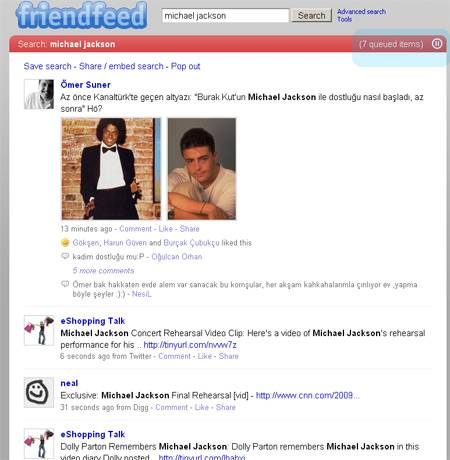
If your business didn't have enough reasons to set up a FriendFeed account before, it has a very good one now. Last week, FriendFeed launched its real-time search feature. Results for this roll in when something that fits the query is posted somewhere. Think Twitter Search, only covering a bunch of services.

If you're unfamiliar with FriendFeed, it allows users to add their updates from pretty much any service on the web into one stream. For instance, I could include my How to make money articles, my Make money online articles, my tweets, my Facebook status updates, my Digg activity, my YouTube uploads, my Flickr uploads, etc. all in one stream where people can go or subscribe to if they want to stay up to date on all things GuruMonetizer or Ervin H.

Clearly, there is plenty of potential for such a tool from the business perspective. Look at all of the services you can add to the stream:

Services on Friendfeed

There are a number of real time search engines out there right now. They seem to be coming out of the woodwork in fact. Most of them cover more than just Twitter too. Twitter kind of kicked off the whole real-time search party, and tweets are definitely a big part of the picture, but there is activity going on everywhere on the web. The whole web is pretty much social now. Everyone can publish anything they want, and they have tons of sites to use to do so.

FriendFeed is about consolidating all of this. That's what draws users to it. FriendFeed is more than a search engine obviously. It is a community. In fact, it's more than a community. It's a community for communities. Even as it draws from sources all over the web (as specified by the users), the conversation continues right within FriendFeed's own interface.

People are going to FriendFeed just as if they would Facebook. That is where FriendFeed's new real-time search stands out from other real time search engines. People are still using Google for search. If they want to find out what's happening "right now" they probably go to Twitter.

A more accurate picture of what is going on "right now" however, can probably be found at FriendFeed. Out of the real time search engines out there, FriendFeed is the one that already has an established (and growing) community behind it. People are using it. Now that its real-time search functionality is here, expect people to use that plenty.

FriendFeed Real Time Search (pause)

FriendFeed has climbed significantly over the last year in terms of unique visitors. There is a good chance it will continue to grow as the web continues its trend of becoming more social and people look to consolidate their social media streams.

So the more FriendFeed grows, the more people will realize that they can search in real-time throughout content across Twitter, Facebook, YouTube, and all of the others shown in the image above. The only problem with this is that the results will only come from what is being shared via FriendFeed.

That's where you come in.


If you do not have a FriendFeed account and have all of your relevant accounts and postings going into your stream, you will be missing out on appearing in users' real-time searches.

This may become less of an issue when Google finally begins offering up real-time search. People are going to be using Google when they want to search for something for the foreseeable future. Once they add real-time search into the fold, I would imagine it will be the first place many turn for that as well.

We know it's coming, but we don't know when. Co-founder Larry Page has publicly acknowledged that it's something the company has to do. Actually, Marissa Mayer, VP of search product and user experience was just talking about the importance of real-time search again.

But for the time being, FriendFeed may be at an advantage in the real-time search space as far as looking at real-time info from across the whole web, and not just what people are saying on Twitter. At the very least, it should make for an important tool in the real-time search toolbox, which as a whole, is very important for online reputation management.

Following are a few other articles worth reading for getting a better understanding of some benefits you can get from using FriendFeed, beyond just the real-time search aspect:

- Why You Should Use FriendFeed

- 10 Ways to Get more Out of FriendFeed

- How to Use FriendFeed as a Collaborative Business Tool

- How Bloggers Can Use FriendFeed Effectively

| 0 comments ]

Smartphone users now have their own version of YouTube. The company says that smartphone users with "capable" browsers like the iPhone, G1, and Palm Pre can access the mobile site.

Dwipal Desai"As more and more people are using the browser on their smartphones for checking email, visiting websites, and even accessing YouTube, we want to make sure that we provide the best possible YouTube experience on your mobile browser," says YouTube Product Manager Dwipal Desai.

Users can log into their account, view their favorites, and find and share videos just like normal. "It's part of our mission to create the best possible YouTube experience for you, whether you use the site on your computer, in your living room, or on the go," says Desai.

To access the new mobile site, just go to YouTube.com from your mobile phone. From there you'll be taken to a new website designed specifically for your mobile device.

This version of YouTube is not available on all devices, keep in mind. According to some people commenting on YouTube's announcement, it doesn't work on the Blackberry Bold, or the Sony PSP, to name a couple.

It's gong to be wise for YouTube to be optimized for as many devices as possible, especially now that it has its own AdSense-type program. The site is also catering to new a lot more these days, which could increase demand for the site for users on the go.

| 1 comments ]

Digg is putting a new spin on targeted advertising. It is always the goal of advertisers to target their ads as well as they can, but when you advertise with Digg, it will cost you if they're not relevant enough.

Digg announced earlier this year that it would be introducing ads. It was hard to tell if users would find this to be a good idea or not, but the concept behind the ads seems quite user friendly. The ads are clearly marked as such, and users get to vote them up or down just like regular Digg content. Digg explains how it works to Digg users:

Your Diggs, buries and clicks influence a quality score that determines how often the ad gets displayed, and ultimately how much the advertiser pays per click. The more you Digg an ad, the less the advertiser will have to pay; the more an ad is buried, the more the advertiser is charged, eventually pricing it out of the system. The success of this system depends on your participation and feedback, as it will help advertisers to create the best possible experience for the Digg community. Our goal with Digg Ads is to encourage advertisers to create content as compelling as organic Digg stories, and to give you more control over which ads you see on Digg.

Screenshot of Digg Ads in action

Advertisers pay less, the more popular their ad is. The less popular it is, the more they pay. To be successful with Digg's new advertising program, you're really going to have to offer what Digg users want. That means knowing what Digg users really like. So basically, you have to offer some kind of Digg-related product. After all, Digg stories are usually the ones that get dugg the most. I'm kidding (at least half kidding).

Either way, it will pay to really get to know the Digg community before just going for it and advertising your product. Study what kinds of stories are most popular. Get a feel for the kinds of content Diggers like. Then evaluate your product against that. Is it something that is really going to get votes with this crowd? If not, you're going to be better off spending your advertising dollars elsewhere. The less the Digg community likes your ad (or product), the more you're going to have to pay to advertise it there. There's not a whole lot of point to paying more for less enthusiasm.

Digg has begun rolling out the ads and they will appear in rotation in various places around the site. Right now, they're only testing them, so many users will not see them yet.

| 0 comments ]

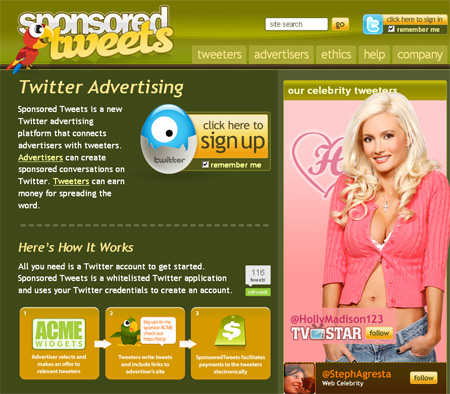
Izea has launched thier paid tweeting service (discussed in the original article) on its own site at SponsoredTweets.com.

Sponsored Tweets

Original Article: Will advertising kill Twitter? Probably not, but it might kill the popularity of the Twitterers tweeting the ads if some consideration isn't put into it.

The concept is nothing new. Don't like the ads you are getting in an email subscription? You'll probably unsubscribe. Don't like paid posts on a blog you read? You'll probably stop reading. I don't see why the same principal wouldn't apply to Twitter.

Word is that popular blogger Perez Hilton is making big-money deals to do some paid tweeting. Some will be quick to point out that this kind of behavior will ruin Twitter, but really, it will just piss off Perez Hilton's followers at worst. If it pisses them off enough, they'll just stop following him. At best, he is selective with his sponsored tweets and does not alienate his audience, and makes some nice bank while he's entertaining his fans (not that he isn't already doing that).

Perez - Please don't spam us!

Here's some stats about Hilton's blog audience from his own advertising page:

Twitter Ads Perez Hilton averages 250 million impressions and 10.5 million unique readers per month.

* 88% female
* 9% age 18-20
* 70% age 21-34
* 14% age 35-45
* 90% have attended college
* 60% earn $60,000 or greater (HHI)


On Twitter, he has 1,008,960 (at the time of writing) followers. And look at what Facebook and Twitter have done for his traffic. It's no wonder sponsored tweets from him would be attractive to advertisers.

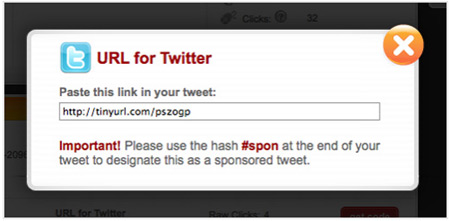
Of course there are others out there doing this already. Heard of PayPerPost? Izea, the company behind that offers services where advertisers can pay for sponsored tweets, complete with unique tracking URLs and everything. Marketers pay for Twitter advertising campaigns on a Cost Per Click (CPC) basis.

URL for Twitter

Izea says its sponsored tweets are all marked with the hashtag #spon. This can lead to scenarios like this where many people are retweeting sponsored tweets:

Blockbuster sponsored tweets

Could this annoy followers? Sure. You're taking your following into your own hands when you go the sponsored tweet route. I don't think this will ruin Twitter for the followers as much as it could for the ones tweeting the sponsored links if they are not considerate with their sponsored tweets. It's a reputation issue. Do you want to be known as the guy pushing ads on people all the time?

Quality and audience factor in as well. "Sponsored" often comes with a negative connotation attached to it, but it isn't always a negative, even from the reader's point of view. If you are tweeting a sponsored link for a something your followers might actually be into, I don't see why they would mind.

Choose your tweets carefully. This is a good rule to live by sponsored tweets or no sponsored tweets. And if they're sponsored, you better mark them as such, or you are bound to alienate people. I'm not sure where the FTC stands on paid tweeting, but that could be a whole other set of problems.

Make Money Now!!

An online guru making more in a single month than most people make in a year is finally revealing his top money making opportunity.  Click here to learn more.
If you wish to no longer receive emails, please click here.
Or write to: Suite 208 – 260 West Esplanade North Vancouver, B.C. V7M3G7 Canada