| 0 comments ]

Google Labs has launched an interesting new gadget that allows users to create a Google Checkout store in gadget form to use on their blog or web site. According to Google the process is as simple as three easy steps:

1. Sign up for a Google Checkout account

2. Fill out a Google Docs Spreadsheet

3. Set up and insert you gadget

Sounds easy enough. Easily create an online store using a Google Docs spreadsheet. Interesting indeed. "No complicated coding or technical tasks are required," says Google on the gadget's homepage. "You can get your first online store up-and-running in under five minutes."

As business owners and non-business owners alike look to sell stuff online to make money online in a less than ideal economy, a simple way of setting up a store can be just the ticket. With this gadget, once users sign up for Google Checkout, they can list their products in the spreadsheet and manage their inventory right in Google Docs.

The gadget itself can be embedded anywhere, which could be incredibly useful, particularly to those sellers who operate more than one site. In fact, online business owners are often encouraged to blog. Wouldn't it make sense to have the store embedded right on the blog, for easy access? I think it would in many cases.

The gadget comes in three different sizes - large, small, and tiny. Here is how they look in comparison to one another:

Google Store Gadget

Google Store Gadget

Google Store Gadget

When it comes to making the spreadsheet available to customers, you can do this by clicking "share" in the upper right-hand corner in Google Docs Spreadsheets. Then you choose "publish as a web page" from the drop down menu, and make sure that the "automatically re-publish when changes are made" option is checked. Then just click "start publishing".

If you have any trouble using it, Google runs down the whole process here. They have also set up a Google Checkout store gadget forum.

It should be noted that this gadget being a project of Google Labs means that it is still in the experimental stage. Does that mean you can't use it? Of course not. Let's not forget that Gmail just left its "beta" status this year. But with the gadget being a lab, just know that it could have bugs.

| 0 comments ]

Google has taken an opportunity to remind North American AdSense publishers that the fastest way to receive payments is through Electronic Funds Transfer (EFT).

"We want to get you paid by the fastest means possible," says Elizabeth Ferdon of the AdSense Payments Team.

AdSense "EFT is quick and easy to set up. When payments are issued, there's no need to wait for the delivery in the mail -- the funds appear in your bank account shortly after they're issued," she adds. "That means if we processed a payment for you this month, your earnings would be in your bank account already."


Signing up for ETF through Google is a three-step process:

1. Enter your bank account info

2. Find your test deposit

3. Enter the test deposit amount in your AdSense account.

To enter your bank account info, just go to "my account" and click the "edit link next to the "payment details" header. Then in the Electronic Funds Transfer section, select the "add new bank account" radio button, and click continue. Enter the requested info and save the changes.

Test deposits can take a few days, and on your bank statement, they will be labeled as one of the following:

- AFS RE GOOGLE
- AFS RE GOOGLE ADSENSE
- ARVATO FINANCE SERVICES LIMITED
- BFS FINANCE LTD
- CITIBANK IRELAND FINANCIAL SERVICES
- Google AdSense Payment

Once you have your test deposit amount, click the "my account" tab, and in the "payment details" section, click "verify this account." Enter the test deposit amount that you received in your bank account in the box, and click "next." Your bank account will be approved and you can select it as your default payment method.

Currently, Google offers Western Union in 23 countries and courier service in a number of others as payment options. Other regions where EFT isn't offered are reminded that Google is continuously working on expanding payment options in more places.

| 0 comments ]

More than 20 percent of commercial, permission-based email does not reach the inboxes of intended subscribers in the United States and Canada, according to email management firm Return Path.

The study found emails reached only 79.3 percent of inboxes in the United States and in Canada during the first half of 2009. With the undelivered email, 3.3 percent is routed to a junk or bulk email folder and 17.4 percent is not delivered at all.

George Bilbrey
George Bilbrey

"Many marketers aren't even aware that one-fifth of their emails are never reaching the inbox," said George Bilbrey, President, co-founder, Return Path. "In many cases, marketers are seeing 'delivered' metrics that repeatedly show a 95% to 98% delivery rate. Unfortunately, many ESPs and marketers have developed the belief that whatever emails aren't bouncing have successfully reached the inbox."

"That's just not true, as these numbers show. Marketers need to examine their current deliverability stats, and remember that hard bounces aren't the only emails that aren't reaching your subscribers."

The U.S. deliverability rates are slightly better than Canada with an average of 82 percent reaching their destination, while Canada's inbox rates are lower with 75 percent of emails landing in subscriber's inboxes.

Successful deliverability to subscriber's inboxes varies by ISP. The top five U.S. ISPs ranked in order of difficulty for marketer's emails to reach user's inboxes are Gmail, Hotmail, MSN, Comcast, and AOL.

Non-delivery Rates by ISP (US)

Marketers have an even more difficult time reaching business email addresses that are protected by email monitoring systems such as Postini, Symantec and MessageLabs. On average, 27.6 percent of commercial emails sent to business addresses don't reach the inbox.

"As ISPs continue their daily battle to keep consumers' inboxes protected from the onslaught of spam, legitimate commercial emails that consumer want to receive aren't being delivered," said Bilbrey.

"It's imperative that marketers dig into their deliverability stats to truly see how many of their emails are successfully reaching the inbox."

| 0 comments ]

For at least the next three years, Google will play a significant role in the delivery of New Zealanders' mail. The Postal Services Group of New Zealand Post has entered an agreement that'll have it putting Google Apps in front of 2,100 employees.

This counts as Google's largest commercial deal yet in New Zealand or Australia. It's supposed to save New Zealand Post (which is a state-owned enterprise) in the neighborhood of $2 million over the course of three years.

Also, Postal Services CEO Peter Fenton said in a statement, "This will increase our ability to work collaboratively." And he claimed, "Google Apps will help us retain our people and attract the next generation of talented graduates."


If all goes according to plan, then, Google will have achieved quite a lot while in a very public position. So it's possible that this development will lead to other businesses in the region adopting Google Apps. Other postal entities (or entire cities) might follow suit, too.

Of course, Google will probably first have to spend at least a few days shooting down conspiracy theories about how it might now have access to people's physical mail.

| 0 comments ]

Companies have long had problems putting numbers on social media marketing results. Wetpaint and the Altimeter Group have now released a study looking at how engagement with consumers through social media correlates with financial performance.
The "ENGAGEMENTdb study" shows that companies who measured as having "the greatest breadth and depth of social media engagement" grew revenues by 18% over the last year, while the companies that were the least engaged dropped 6% on average.

Charlene Li "This is the first study of this depth on the top global brands and we think the results provide a good guide for corporations and brand marketers in every industry," says Charlene Li, Founder, Altimeter Group. "The success stories we have uncovered provide a blueprint for companies making decisions about how to best apply their marketing and consumer relations resources."

Channels taken into consideration for the study were:

- Blogs
- Facebook
- Twitter
- Wikis
- Discussion Forums

Brands looked at were the 100 most valuable ones as identified by the 2008 BusinessWeek/Interbrand Best Global Brands ranking. In case you were wondering what the top ten brands are according to the ENGAGEMENTdb study, they are as follows:

1. Starbucks
2. Dell
3. eBay
4. Google
5. Microsoft
6. Thomson Reuters
7. Nike
8. Amazon
9. SAP
10. Yahoo!/Intel (Tie)
Engagementdb graph - Starbucks on top
So what are these brands doing right?

According to Wetpaint and the Altimeter Group, the companies that scored well have dedicated teams (of varying sizes) who are active in the social media channels they utilize. Basically, it shows that it pays (literally) to have a team working full time on engaging with customers via social media. Even if that team consists of one person, it means they will not be distracted by other tasks and can give the social channel the attention required for it to make a significant impact.

As the social web continues to grow (meaning more people joining social networks, more people blogging, and more sites becoming social), there is a growing number of channels that require said attention.

Ben Elowitz "The ENGAGEMENTdb study goes a long way towards validating the importance of social media for business," says Ben Elowitz, CEO of Wetpaint. "The closer any company is to its customers, the better, and it's hard to argue with the ability for social media to create such proximity. In this day and age, companies should feel much more comfortable investing in social media -- the correlation to results is so clear."

It is in fact that clarity that many companies have had a hard time seeing in the past. Social media is still in its early stages though really. In the grand scheme of things, it's still a relatively new concept. Keep in mind, that many businesses still do not even have websites, let alone a social media presence.

It is going to take studies like this and concrete data showing the financial benefits for more small businesses to truly get on board and engage. Having dedicated teams is a strategy that will likely become more commonplace as companies realize that half-assing it is just a waste of time.

A couple of other highlights from the study:

- The study found that the most successful teams evangelize social media across the entire organization to pull in a broad range of stakeholders.

- These companies view social media as an indispensable tool to help them achieve results, and their approach is conversational.


Along with the study, the ENGAGEMENTdb site was launched as a tool where companies can measure themselves against the top 100 in terms of the strength of their social media efforts. It's probably not a bad idea to take a look if you're serious about those efforts.

| 0 comments ]

Google released its second quarter earnings report this afternoon, and the search giant met and beat most analysts' written estimates. Its bottom line in terms of profit looked especially good.

The consensus was that Google would post $4.05 billion in net revenue. It managed $4.07 billion, instead. Then the company established a more impressive contrast when it came to earnings per share - $5.35 versus $5.05 - although Henry Blodget wrote, "the EPS upside appears to have come from a lower-than-expected tax rate."

As for net profit, Google leapt from $1.25 billion for the second quarter of last year to $1.48 billion, a jump of 18.4 percent. That doesn't look to be a result of being tentative, as the official report announced, "We expect to continue to make significant capital expenditures."

Eric Schmidt also stated, "Google had a very good quarter, especially given the continued macro-economic downturn. While most of the world's largest economies shrank, Google's year-over-year revenues were up 3%. These results highlight the enduring strength of our business model and our responsible efforts to manage expenses in a way that puts us in a good position for the economic upturn, when it occurs."
Still, Google's down by 2.62 percent in after-hours trading. It may be that some people are doing a little profit-taking, or there could be another problem plaguing the company. Dan Frommer wrote, "CNBC mistakenly reported Google's net sales as $3.07 billion before correcting themselves a moment later."

One last thing worth noting: as of June 30th, Google employed 378 fewer full-time employees than it did on March 31st, so some significant cutting has taken place.

| 0 comments ]

The online gaming audience has seen a significant increase in the past year as people are increasingly looking for cheaper entertainment alternatives, driven partly by the economy, according to a new report from comScore.

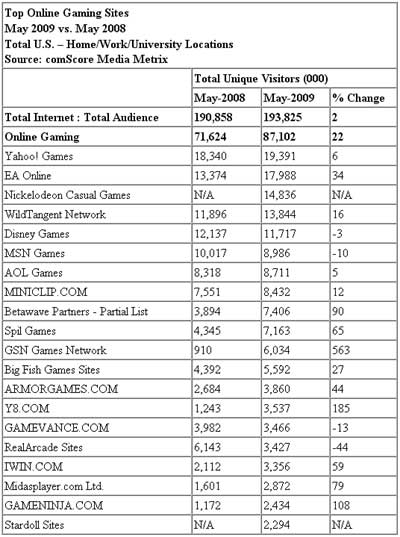
The category attracted 87 million U.S. visitors in May 2009, up 22 percent compared to a year ago.

Yahoo Games was the most popular with 19.4 million visitors, representing a 6 percent increase over the past year, followed by EA Online with 18 million visitors (up 34 %), Nickelodeon Casual Games with 14.8 million visitors, and WildTangent Network with 13.8 million (up 16%). GSN Games Networks saw particularly strong gains in the past year, growing 563 percent to 6 million visitors, due in part to the additions of WorldWinner.com and CrazyMonkeyGames.

"Online gaming continues to be one of the top gaining categories over the past year growing at ten times the rate of the total U.S. Internet population and reaching nearly one out of every two Internet users," said Edward Hunter, comScore director of gaming solutions.

Top Online Gaming Sites

"And the growth in the category is occurring not only at the top gaming destination sites, but also through viral distribution platforms, including widgets and applications. In fact, some online gaming companies that distributed their games across sites are reaching as many people as the top online gaming sites."

Distributed content platforms can often reach audiences of a size comparable to online gaming destination sites. MochiMedia reached a combined audience of 16.9 million in May, greater than all but two sites in the online gaming category. Games2Win reached 1.8 million people, which compares favorably with the top twenty sites in the category, while Tetris Online reached 165,000 people.

| 0 comments ]

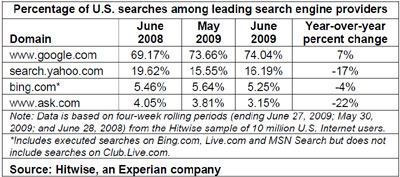
Microsoft's Bing accounted for 5.25 percent of all U.S. searches for the month of June, according to the latest data from Hitwise.

Google continued to hold on to its dominant position growing 7 percent year-over- year capturing 74.04 percent of the U.S. search market for the month.

Yahoo landed in the second position with 16.19 percent of the search market, but saw its growth drop 17 percent year-over-year, while Ask received 3.15 percent of searches with its growth slipping 22 percent year-over-year.

Percentage of U.S. searches among leading search engine providers

The remaining 48 search engines in the Hitwise Search Engine Analysis Tool accounted for 1.36 percent of U.S. searches.

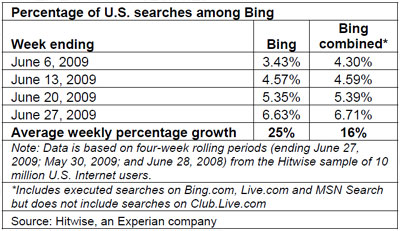
Looking at the weekly percentage of U.S. searches for Bing, it has grown at an average weekly rate of 25 percent for the month of June, Adding in Live.com and MSN Search along with Bing, the combined search engine have grown at an average of 16 percent during the month. Bing grew faster than the three other top search engines for the month.

Percentage of U.S. searches among Bing

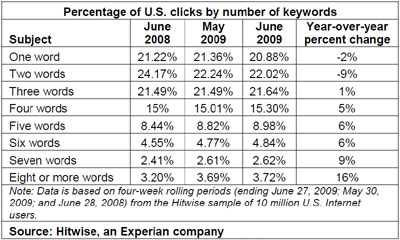
The length of search queries has increased over the past year. Longer search queries, averaging five to more than eight words in length, increased 8 percent between June 2008 and June 2009. Searches of eight or more words increased 16 percent. The same time period showed that shorter queries - those averaging one to four words long - have decreased 2 percent. Searches of two words accounted for the majority of searches, making up 22.88 percent of all queries.

Percentage of U.S. clicks by number of keywords

Search engines continue to be the most popular way Internet users navigate to key industry categories. Comparing June 2009 with June 2008, business and finance, entertainment, online video and sports categories showed double-digit increases in their share of traffic coming directly from search engines.

Make Money Now!!

An online guru making more in a single month than most people make in a year is finally revealing his top money making opportunity.  Click here to learn more.
If you wish to no longer receive emails, please click here.
Or write to: Suite 208 – 260 West Esplanade North Vancouver, B.C. V7M3G7 Canada